Did You Know, you can’t sue the manufacturer for a COVID-19 vaccine injury?
Unlike nearly every other product in the U.S., COVID-19 vaccines and other emergency counter measures are shielded from liability. Injured individuals have no right to sue the manufacturer—even in cases of clear harm. Instead, they’re forced into a little-known federal program called the Countermeasures Injury Compensation Program (CICP).
The Problem? CICP is failing.
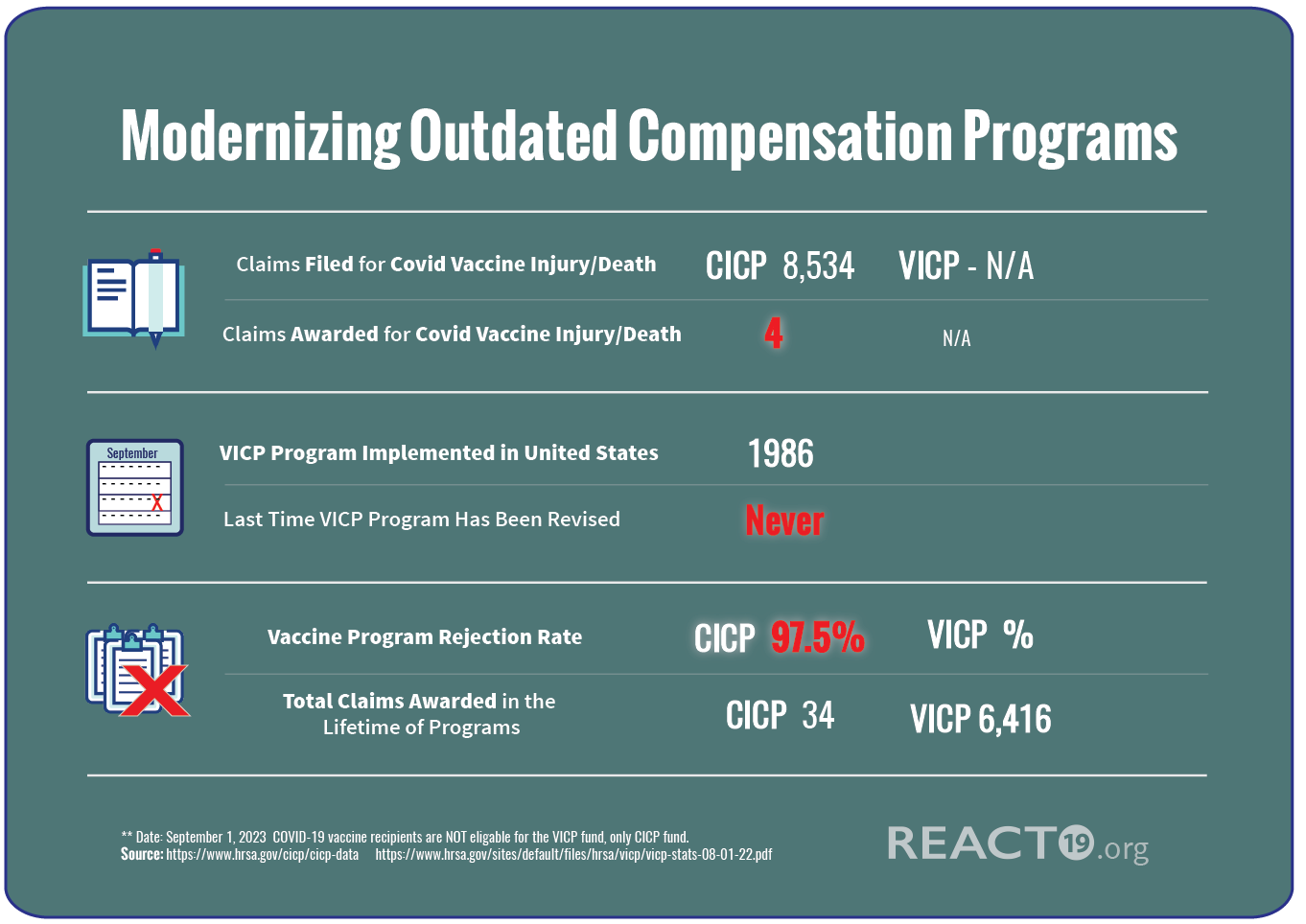
It operates behind closed doors, offers no legal representation, no appeals process, and pays almost nothing. While the Vaccine Injury Compensation Program (VICP) has awarded billions to those injured by vaccines like MMR and flu, the CICP has awarded 60—out of thousands of applicants. The rejection rate is 98.6%.
H.R.9672 Vaccine Injury Compensation Modernization Act of 2026
Providing a reasonable remedy to those harmed during a national health emergency isn't just important — it's a moral and constitutional imperative that upholds public trust and accountability. The Vaccine Injury Compensation Modernization Act of 2026 is bipartisan legislation introduced by Representatives Lloyd Doggett (D-TX) and Lloyd Smucker (R-PA). It modernizes the National Vaccine Injury Compensation Program by:
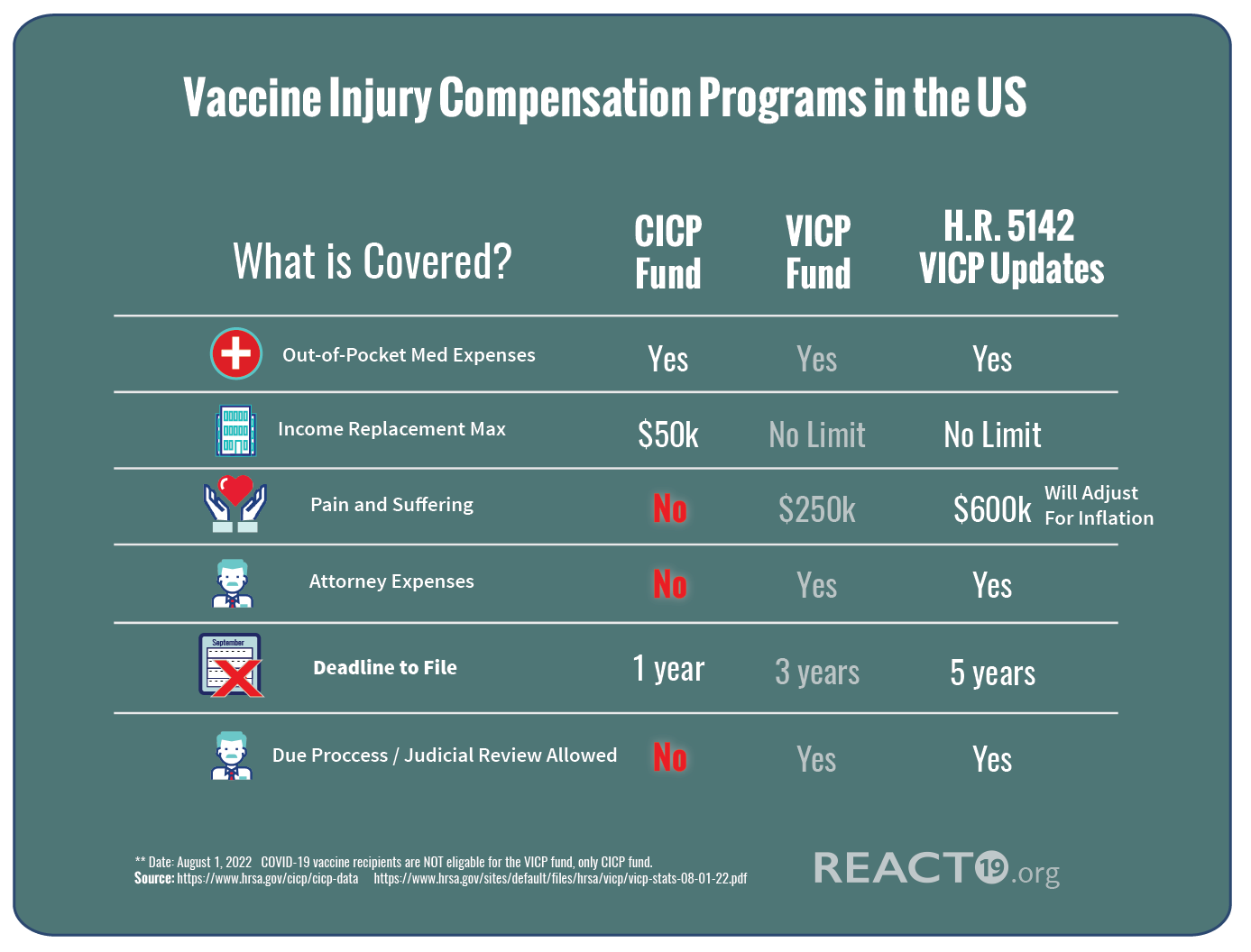
- Expand existing VICP filing window from 3 years to 5 years.
- Allows a one-time opening for current and rejected COVID vaccine CICP claims to re-file with the VICP.(5 year statute of limiations does not apply)
- Allows a one-time opening for COVID vaccine claims to be filed that were NOT previously filed in the CICP.(5 year statute of limiations does not apply)
- Allow lost earnings, medical expenses, pain and suffering.
- Death benefit and pain & suffering increase to $600,000.
** VICP award limits have not changed since 1986. CICP allows medical expenses and lost earnings with a cap of $50,000 for lost earning, and $370,000 for death.
- Claimants have the right to attorney representation and expert witness.
- Denied claims can be appealed to federal courts.
**CICP does not cover attorney fees, nor can denied claims be appealed.
- Increases vaccine tax to the manufacturer from $.75 per vaccine to $2.20 per vaccine.
- ** CICP is taxpayer funded, VICP is vaccine manufacturer funded.
- Requires at least 10 Special Masters (judges) to hear cases.
- Provides Congress with better information to ensure timely claim resolution.
- ** CICP does not have an independent judicial process, the VICP has an existing back-log and has needed more special masters (judges) for years.
React19 maintains that the CICP is fundamentally inadequate for addressing injuries from emergency-use products. Legislative reform is urgently needed to align it more closely with the VICP.
This position reflects input from the vaccine-injured, manufacturers, and leading legal experts. We must learn from the COVID-19 response to strengthen the nation's emergency preparedness for future public health challenges.
CICP v. VICP Comparison
| CICP Fund | VICP Fund | |
|---|---|---|
Filing Deadline | 1 Year | 3 Years |
Approval Rate | 1.4% | 49.3% |
Judicial Process | No | Yes |
Attorney and Expert Fees | No | Yes |
Pain and Suffering | No | Yes |
Attainable Standard of Truth | No | Yes |
Neutral Fact Finder (Special Masters) | No | Yes |
Transparent / Reviewable Decision Basis | No | Yes |
Judicial Appellate Review | No | Yes |
Cases
Million
Billion
¹ CICP claims compensated for COVID-19 vaccines specifically (60 claims, $6.94M). Excludes other CICP-covered countermeasures (e.g., remdesivir, ventilators), which are compensated at inconsistent rates. Source: HRSA, CICP Data, Table 4, as of April 1, 2026 — hrsa.gov/cicp/cicp-data/table-4.
² VICP lifetime totals across all vaccines covered since 1988. COVID-19 vaccines are not eligible for VICP — injured individuals are instead routed to CICP, which is the core disparity this chart illustrates. Source: HRSA, VICP Data and Statistics, report dated March 1, 2026 — hrsa.gov/sites/default/files/hrsa/vicp/vicp-stats-03-01-26.pdf.
³ The single outlier is a Thrombosis with Thrombocytopenia Syndrome (TTS) claim, per HRSA Table 4.
CICP Shortfalls In Depth Look
Filing Deadline: CICP claims must be filed within one year of vaccine administration. No exceptions. It often takes over a year for the vaccine injured to get diagnosed appropriately, and many others are unaware of the program’s existence until after the short one-year deadline has passed.
Finder of Fact and Law:The CICP, as a delegate of the Secretary of Health and Human Services (HHS), determines the merit of vaccine injured claims. The same agency is responsible for reviewing and deciding CICP claims. There is no independent party involved in evaluating whether a claim has merit.
Appeals and Judicial Review: If a CICP claim is denied, there is no option to appeal the decision and no court or independent body that can review it. The agency's singular and initial decision is final.
Standard of Proof: The CICP requires the vaccine injured (without any legal or expert representation to prove that the vaccine directly caused their illness. As COVID vaccine injuries are novel in nature, sufficient scientific evidence simply does yet exist and won't exist for years for the injured to prove their case. And as highlighted above, even the few adverse reactions that are listed on the FDA's vaccine package insert have been denied claims by this program.
Why is this urgent? – Needs Currently Not Met
Loss of Work & Income
Medical Supplies / Home Provisions
Housing/Rent Payments
Medical Care Expenses
"'The countermeasures program['s] largely invisible decisions are 'an incrutable enigma,' said Brain Abramson, an expert on vaccine law."
How the CICP Program is Performing
this program is.
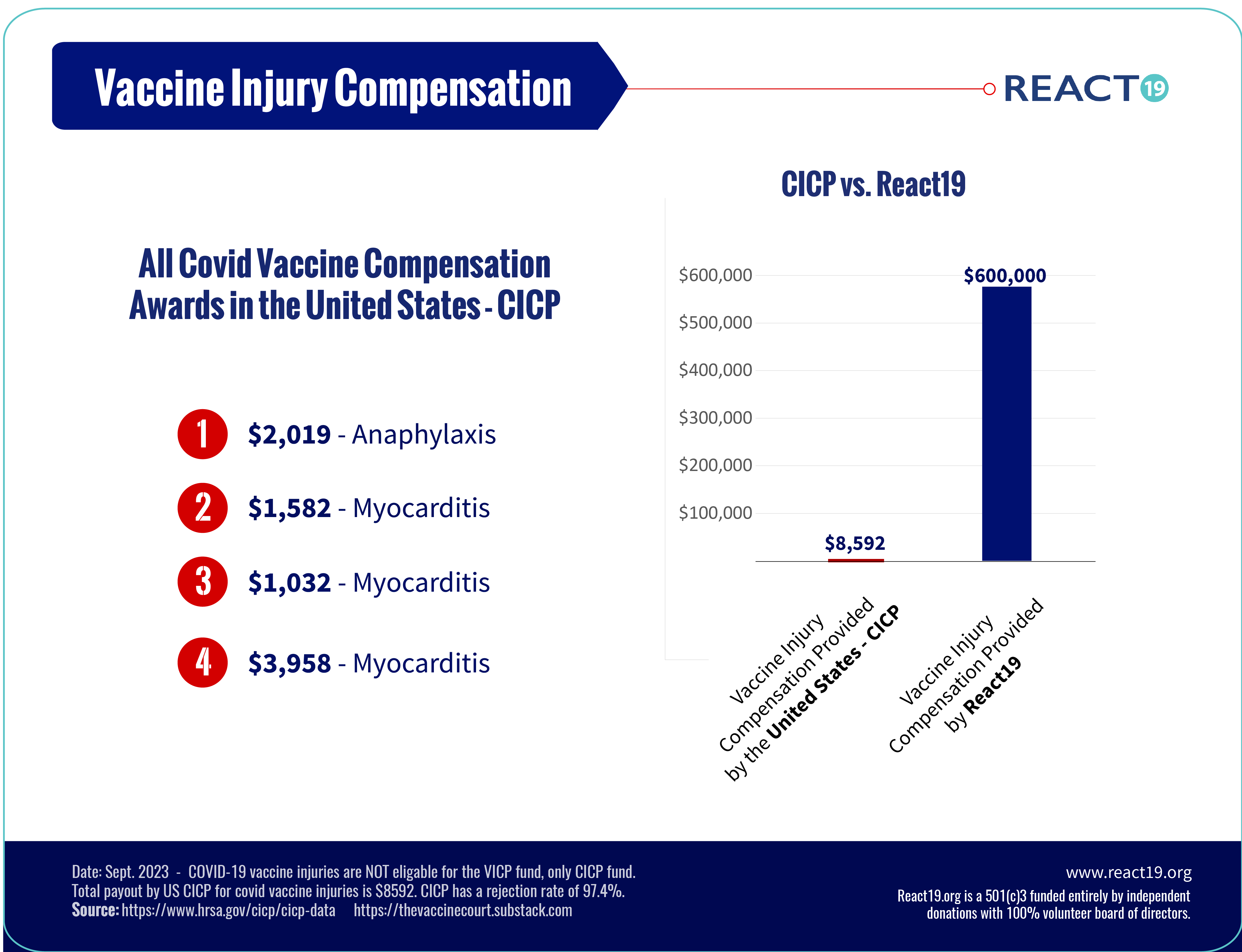
React19 Struggling to Fill the Gap: To date, the U.S. Government have awarded under 51 applicants Covid vaccine injury CICP claims. The average payout is under $5,000. React19 has awarded over $1.9 million in medical grants, for out-of-pocket medical expenses, with donations from everyday Americans.
*React19 is a volunteer organization dedicated to providing physical, financial, and emotional healing to those suffering adverse events after Covid vaccination.
Passing H.R.9642 Vaccine Injury Compensation Modernization Act of 2026 will bring relief to those left behind by the pandemic and strengthen our preparedness for future emergencies.
FREQUENTLY ASKED QUESTIONS
For thousands of Americans, the current system has failed.
Individuals injured by COVID-19 vaccines are generally limited to seeking compensation through the Countermeasures Injury Compensation Program (CICP)—a program that provides few procedural protections and has compensated only a tiny fraction of applicants. Unlike the Vaccine Injury Compensation Program (VICP), the CICP does not pay attorney or expert fees, offers no meaningful judicial review, has no vaccine injury table, and require claims to be filed within just one year.
The results speak for themselves. More than 14,000 COVID-19 vaccine injury claims have been filed, yet less than three percent have received compensation, with many claims denied for procedural reasons before the medical evidence was even evaluated on its merits. But for extreme outliers, the average CICP award is currently less than $5,000, a pittance in comparison to a lifetime of lost wages and exorbitant medical bills.
The Vaccine Injury Compensation Modernization Act of 2026 seeks to restore the original promise behind America's vaccine compensation system: if society asks individuals to accept the rare risks associated with vaccination for the public good, society should also provide a fair, transparent, and accessible compensation system when serious injuries occur.
The Vaccine Injury Compensation Modernization Act of 2026 is bipartisan legislation introduced by Representatives Lloyd Doggett (D-TX) and Lloyd Smucker (R-PA).
The legislation modernizes the National Vaccine Injury Compensation Program by:
- • Allowing COVID-19 vaccine injury claims to be filed in the VICP.
- • Expanding eligibility as additional vaccines are added to the Vaccine Injury Table.
- • Increasing compensation to reflect today's economy.
- • Extending filing deadlines.
- • Increasing transparency and accountability.
- • Expanding program capacity by increasing the minimum number of Special Masters.
For the first time, individuals injured by COVID-19 vaccines would have access to the same compensation system used for other routinely recommended vaccines.
Instead of relying solely on the CICP, eligible claimants could pursue compensation through the VICP, which provides:
- • Independent Special Masters
- • Attorney fee reimbursement
- • Expert witness reimbursement
- • Judicial review
- • Established legal standards developed over nearly four decades
- • More comprehensive compensation
The Vaccine Injury Compensation Modernization Act of 2026 is designed to ensure that everyone injured by a covered COVID-19 vaccine has an opportunity to seek compensation through the Vaccine Injury Compensation Program (VICP).
If enacted, the legislation would allow the following groups to pursue compensation in the VICP:
- Individuals whose CICP claims were denied. A prior denial by the CICP would not prevent you from filing a new claim in the VICP. Your case would be evaluated under the VICP's legal standards rather than the CICP's restrictive compensation system.
- Individuals with CICP claims that are still pending. If your CICP claim has not yet been decided, you would still be eligible to file a VICP petition once COVID-19 vaccines are added to the VICP.
- Individuals who never filed a CICP claim. Many injured people missed the CICP's one-year filing deadline, were unaware the program existed, or chose not to file because of its limited benefits and historically low compensation rate. This legislation gives those individuals a new opportunity to seek compensation through the VICP.
These are two different legal provisions that serve different purposes.
The five-year filing deadline applies to new vaccine injuries occurring after the law takes effect. Under current VICP rules, most petitioners must file within three years of the first symptom of their injury. The legislation extends that deadline to five years, giving future claimants additional time to recognize their injury, obtain a diagnosis, gather medical records, and secure legal representation.
The two-year lookback window is a separate, one-time opportunity for people who were injured before COVID-19 vaccines were covered by the VICP. Once COVID-19 vaccines are officially added to the VICP, existing VICP law opens a special filing period. During that two-year window, individuals with prior COVID-19 vaccine injuries may file a VICP petition even though their injuries occurred years earlier.
In short:
- Five-year filing deadline: Applies to future injuries occurring after COVID-19 vaccines are covered by the VICP.
- Two-year lookback window: Applies to past injuries, giving those already injured a limited opportunity to bring their claims into the VICP after COVID-19 vaccines are added to the program.
The legislation is intended to ensure that both future claimants and those who have already spent years without an adequate remedy have a meaningful opportunity to seek fair compensation.
The bill updates compensation amounts that have not kept pace with inflation.
Among other improvements, it would:
- • Increase the maximum death benefit to $600,000.
- • Attorney fee reimbursement
- • Increase the maximum award for pain and suffering to $600,000.
- • Preserve compensation for medical expenses and lost earnings already available under the VICP.
These changes recognize the true financial impact that catastrophic vaccine injuries can have on individuals and families.
Yes. The legislation improves access without lowering the legal standard for proving a vaccine injury.
Key reforms include:
- • Extending the VICP filing deadline from three years to five years. (does not apply to those already injured by the COVID vaccines)
- • Requiring HHS to act much more quickly when new vaccines should be added to the Vaccine Injury Table.
- • Allowing additional time for individuals whose injuries occurred years earlier to seek compensation.
- • Improving program transparency and reporting.
The goal is not to guarantee compensation—it is to ensure injured individuals receive a fair opportunity to present their claims.
In the context of COVID vaccines, no.
The legislation does not repeal the PREP Act or remove existing liability protections for vaccine manufacturers.
Instead, it strengthens the government's commitment to compensate individuals who experience rare but serious vaccine injuries while preserving the liability framework that Congress has established.
The Vaccine Injury Compensation Program is funded through a federal excise tax on covered vaccines—not through general taxpayer revenue. The legislation updates that funding mechanism to reflect today's vaccine market and the addition of newly covered vaccines.
Independent financial modeling indicates the Trust Fund remains financially sustainable under a wide range of assumptions while expanding benefits and covering additional vaccines.
No.
Although COVID-19 vaccine injuries are a major focus, the legislation modernizes the entire Vaccine Injury Compensation Program.
It:
- • Improves benefits for all future claimants.
- • Adds additional vaccines, including RSV, shingles, and dengue vaccines, as they become covered.
- • Requires faster action when newly recommended vaccines should enter the compensation system.
- • Improves transparency and program administration for everyone using the VICP.
React19 believes Americans who suffer serious vaccine injuries deserve the same fairness, due process, and compassion afforded to others injured by routinely recommended vaccines. While no legislation is perfect, this bill represents the most significant reform to the vaccine compensation system in decades.
It expands access to compensation, modernizes outdated benefit levels, improves transparency, strengthens due process, and helps restore public confidence that government will stand behind the rare individuals who experience serious vaccine injuries.
As React19 has stated, meaningful progress often requires working with diverse stakeholders to achieve real results rather than accepting continued inaction.
Public engagement is essential.
You can help by:
- • Contacting your U.S. Representative and Senators and asking them to support the Vaccine Injury Compensation Modernization Act of 2026.
- • Sharing your personal story with your elected officials.Call your legislators Email your legislator
- • Sign up for React19's newsletter for the latest udpates on the legislation.
- • Share this legislation and call to action on your social media.
- • Asking your healthcare providers, patient organizations, and community leaders to support a fair vaccine injury compensation system.
Every phone call, email, letter, and meeting with elected officials helps demonstrate that Americans believe those who experience vaccine injuries deserve fairness, due process, and compassionate support.
Sources
Press
Other Sources
● HRSA, Countermeasures Injury Compensation Program (CICP) Data, aggregate data as of April 1, 2026 — www.hrsa.gov/cicp/cicp-data
● HRSA, CICP Data, Table 4 — CICP Claims Compensated (Fiscal Years 2010–2026), as of April 1, 2026 — www.hrsa.gov/cicp/cicp-data/table-4 (totals for the 51 compensated COVID-19 vaccine claims calculated from the published per-claim table)
● HRSA, National Vaccine Injury Compensation Program (VICP) Data and Statistics, report dated March 1, 2026 — www.hrsa.gov/vaccine-compensation/data
● Congressional Research Service, CICP/VICP comparison — www.crsreports.congress.gov/product/pdf/LSB/LSB10584
● React19 internal figures: $2.0M in medical hardship grants to members (provided by React19)